Balance Sheet Template
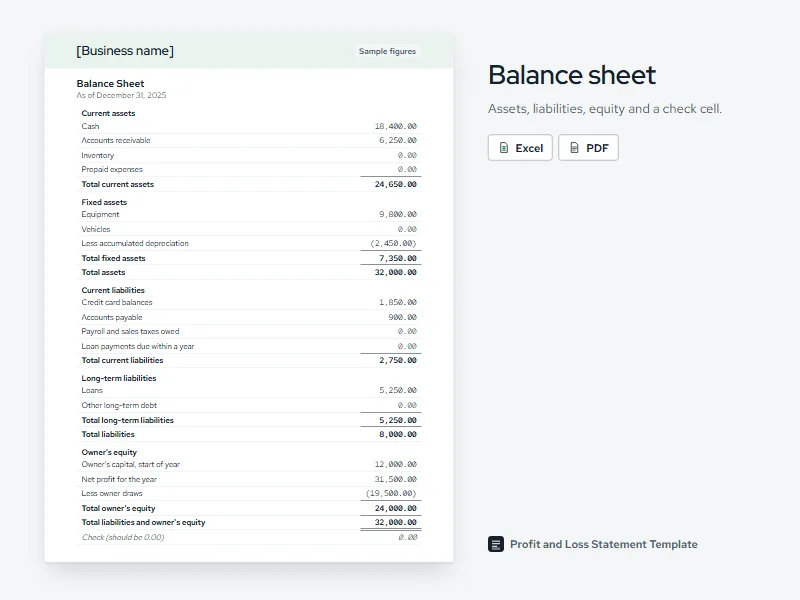
Assets on one side, what you owe and own on the other, and a check cell that tells you if it balances.
It sits beside the P&L layouts on our profit and loss statement template page. Free, with no sign-up.
What is in this template
The template is built for a small business owned by one person or a few partners. It has five sections and a check row:
- Current assets: cash, accounts receivable (money customers owe you), inventory and prepaid expenses.
- Fixed assets: equipment and vehicles, less the depreciation taken on them so far.
- Current liabilities: credit card balances, bills you owe suppliers, taxes collected or withheld but not yet paid, and loan payments due within a year.
- Long-term liabilities: loans and other debt due after the next twelve months.
- Owner's equity: your capital at the start of the year, plus the year's net profit, less owner draws.
The check row subtracts total liabilities and owner's equity from total assets. When it reads 0.00, the sheet balances. A corporation would show retained earnings in place of owner's capital and draws; rename those lines if that is your structure.
| Item | Amount |
|---|---|
| Current assets | |
| Cash | |
| Accounts receivable | |
| Inventory | |
| Prepaid expenses | |
| Total current assets | |
| Fixed assets | |
| Equipment | |
| Vehicles | |
| Less accumulated depreciation | |
| Total fixed assets | |
| Total assets | |
| Current liabilities | |
| Credit card balances | |
| Accounts payable | |
| Payroll and sales taxes owed | |
| Loan payments due within a year | |
| Total current liabilities | |
| Long-term liabilities | |
| Loans | |
| Other long-term debt | |
| Total long-term liabilities | |
| Total liabilities | |
| Owner's equity | |
| Owner's capital, start of year | |
| Net profit for the year | |
| Less owner draws | |
| Total owner's equity | |
| Total liabilities and owner's equity | |
| Check (should be 0.00) | |
How to fill it in
Pick the date
A balance sheet is a snapshot. Year end or the last day of a month is easiest, because your bank statements end there too.
List what the business owns
Cash from the bank statements, invoices customers have not paid, stock on hand, and equipment at what it cost.
List what it owes
Card balances, unpaid bills, taxes collected but not yet paid, and every loan balance from the lender's statement.
Work out equity
Start with last year's ending equity, add this year's net profit from your P&L and subtract your draws.
Check that it balances
The check row should read 0.00. If it does not, the gap is the size of what is missing or doubled.
An example that balances
A made-up design studio owned by one person, as of December 31, 2025. The studio owns 32,000.00 in all; it owes 8,000.00, and the other 24,000.00 is the owner's equity. Both sides come to 32,000.00.
| Line | Amount |
|---|---|
| Assets | |
| Cash | 18,400.00 |
| Accounts receivable | 6,250.00 |
| Equipment | 9,800.00 |
| Less accumulated depreciation | (2,450.00) |
| Equipment, net | 7,350.00 |
| Total assets | 32,000.00 |
| Liabilities | |
| Credit card balance | 1,850.00 |
| Accounts payable | 900.00 |
| Equipment loan | 5,250.00 |
| Total liabilities | 8,000.00 |
| Owner's equity | |
| Owner's capital, start of year | 12,000.00 |
| Net profit for the year | 31,500.00 |
| Owner draws | (19,500.00) |
| Total owner's equity | 24,000.00 |
| Total liabilities and owner's equity | 32,000.00 |
Not accounting, tax or legal advice. Check every figure before you sign or submit it. Some lenders require a statement prepared by an accountant.
Check it against your statements
Most balance sheet figures can be checked against a document you already have. Cash should match your bank statements on the balance sheet date, card balances should match the card statements, and each loan should match the balance on the lender's latest statement. Accounts receivable should equal the invoices customers have not yet paid.
Equipment is the exception: it stays at what you paid for it, less the depreciation taken so far. If you do not track depreciation yourself, your tax preparer's depreciation schedule has the figure.
How the P&L feeds the balance sheet
The two statements meet in owner's equity. The year's net profit from the profit and loss statement adds to equity, because profit belongs to the owner; draws the owner took during the year come back off. In the example, equity of 12,000.00 at the start of the year, plus 31,500.00 of profit, less 19,500.00 of draws, gives 24,000.00 at year end.
That link is also why a draw recorded as an expense throws both statements off: the P&L shows less profit than the business made, and equity no longer explains the cash. For the formal layout of the profit side, use our income statement template; a business with stock and staff should use the small business profit and loss statement.
Questions
What is the balance sheet equation?
Assets equal liabilities plus equity. Everything the business owns was paid for either with money it owes to someone else or with money that belongs to the owner. The check cell in the template subtracts liabilities and equity from total assets, and it reads 0.00 when the sheet balances.
How is a balance sheet different from a profit and loss statement?
A balance sheet shows one date: what the business owns and owes, and the owner's stake, on that day. A profit and loss statement covers a period, such as a month or a year, and shows what the business earned and spent during it. You need both to see the full picture.
How does net profit show up on the balance sheet?
Net profit for the year adds to owner's equity, or to retained earnings in a corporation, because it belongs to the owners. Owner draws and distributions reduce it. In the example on this page, 31,500.00 of profit and 19,500.00 of draws move equity from 12,000.00 to 24,000.00.
What counts as a current asset or a current liability?
A current asset is cash or anything you expect to turn into cash within a year, such as money customers owe you. A current liability is anything you expect to pay within a year, such as a credit card balance or a supplier's bill. Longer-term items, like equipment or a multi-year loan, sit in their own sections.
What if my balance sheet does not balance?
Look for something missing or counted twice. Common causes are a loan left off the liabilities, an owner draw recorded as an expense, a figure typed into the wrong row, or a number typed with the wrong sign. The check cell shows the size of the gap, which often points straight at the missing amount.
How often should I update my balance sheet?
At least once a year, at year end, and whenever a lender asks for one. Many small businesses update it every month alongside their profit and loss statement, because it needs only a few figures from bank, card and loan statements. The date at the top shows which day the balance sheet describes, so date it every time.