Self Employed Profit and Loss Statement
Schedule C style categories, a signature line, and the items that never belong on it.
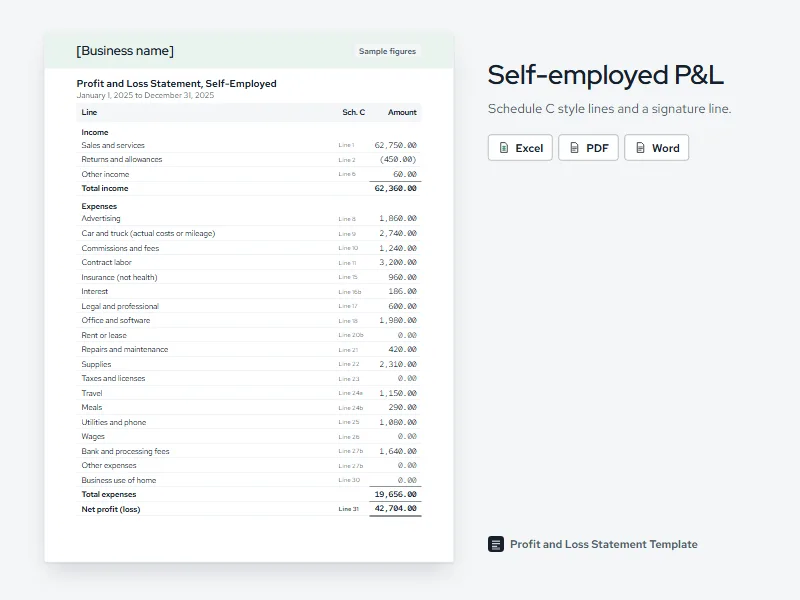
This is one of the free layouts on our profit and loss statement template page. If you would rather type into a form, the fillable profit and loss statement PDF adds up as you go.
What a self-employed P&L needs
A self-employed P&L uses the expense lines of IRS Schedule C, the form most sole proprietors file with their federal return to report business profit. When the statement and the return use the same categories, anyone who reads both can see they agree, and moving the year's totals onto the return is a matter of copying figures across.
The template lists each line with the Schedule C line it usually maps to. Two lines are easy to miss: returns and allowances, which reduce income rather than adding an expense, and business use of home, which sits after the other expenses on the form. At the bottom there is room for your signature, the date, and your name and title, because the people who ask a self-employed person for a P&L usually want it signed.
| Line | Schedule C line | Amount |
|---|---|---|
| Income | ||
| Sales and servicesSchedule C line 1 | Line 1 | |
| Returns and allowancesSchedule C line 2 | Line 2 | |
| Other incomeSchedule C line 6 | Line 6 | |
| Total income | ||
| Expenses | ||
| AdvertisingSchedule C line 8 | Line 8 | |
| Car and truck (actual costs or mileage)Schedule C line 9 | Line 9 | |
| Commissions and feesSchedule C line 10 | Line 10 | |
| Contract laborSchedule C line 11 | Line 11 | |
| Insurance (not health)Schedule C line 15 | Line 15 | |
| InterestSchedule C line 16b | Line 16b | |
| Legal and professionalSchedule C line 17 | Line 17 | |
| Office and softwareSchedule C line 18 | Line 18 | |
| Rent or leaseSchedule C line 20b | Line 20b | |
| Repairs and maintenanceSchedule C line 21 | Line 21 | |
| SuppliesSchedule C line 22 | Line 22 | |
| Taxes and licensesSchedule C line 23 | Line 23 | |
| TravelSchedule C line 24a | Line 24a | |
| MealsSchedule C line 24b | Line 24b | |
| Utilities and phoneSchedule C line 25 | Line 25 | |
| WagesSchedule C line 26 | Line 26 | |
| Bank and processing feesSchedule C line 27b | Line 27b | |
| Other expensesSchedule C line 27b | Line 27b | |
| Business use of homeSchedule C line 30 | Line 30 | |
| Total expenses | ||
| Net profit (loss)Schedule C line 31 | Line 31 | |
Prepared by the owner from bank and card records. Not audited.
What to leave out
When you work for yourself, business and personal money often share one account, so the bank shows plenty of movements that are not business income or costs. Keep these off the statement.
- Owner draws. Money you pay yourself is how you take the profit, not a cost of earning it.
- Transfers to savings or personal accounts. Moving money between accounts you own changes where it sits, not what the business made.
- Estimated tax payments. Quarterly payments toward your own income tax are a personal tax cost, not a business expense on this statement.
- Loan principal. The part of a loan payment that repays the balance is not an expense. The interest part is, on the interest line.
- Personal spending. Groceries, family phones and personal subscriptions paid from the business account belong to you, not the business.
None of these lower the profit, and a statement that subtracts them shows less income than you really earned, which is the opposite of what a lender or landlord wants to see.
Mileage and home office
Car costs and a home office are the two lines self-employed people most often get wrong on a P&L. Include them only if you claim them on your tax return, and use the same method on both.
For a car, the choice is usually between actual costs (gas, repairs, insurance and the rest, for the business share of your driving) and a standard mileage rate set by the IRS. For a home office, the IRS has a regular method figured on Form 8829 and a simplified method based on the office's floor area. Your tax preparer can tell you which methods you use. This page does not state any rates, because they change and the right one depends on your situation.
Why lenders, landlords and agencies ask for it
A self-employed person has no pay stubs, so anyone deciding whether to lend to you, rent to you or sign you up needs another way to see your income. Your last tax return shows last year; a P&L shows what has happened since.
Mortgage lenders often ask for a YTD profit and loss statement, from January 1 to the end of the last full month. Landlords may want the last twelve months, and agencies may ask for a recent month or quarter. Whoever asks will usually compare it with your bank statements, so build it from the same records, sign it and date it.
A worked example
A made-up self-employed photographer, one full year, with the Schedule C column filled in. The four items under the statement were in the bank records but are not business income or expenses, so they are listed for reference only. Six more businesses, from a cafe to a rental duplex, are in our profit and loss statement examples.
The Schedule C column is a common mapping. Check it with your tax preparer.
| Line | Schedule C line | Amount |
|---|---|---|
| Income | ||
| Sales and services Schedule C line 1 | Line 1 | 62,750.00 |
| Returns and allowances Schedule C line 2 | Line 2 | (450.00) |
| Other income Schedule C line 6 | Line 6 | 60.00 |
| Total income | 62,360.00 | |
| Expenses | ||
| Advertising Schedule C line 8 | Line 8 | 1,860.00 |
| Car and truck Schedule C line 9 | Line 9 | 2,740.00 |
| Commissions and fees Schedule C line 10 | Line 10 | 1,240.00 |
| Contract labor Schedule C line 11 | Line 11 | 3,200.00 |
| Insurance Schedule C line 15 | Line 15 | 960.00 |
| Interest Schedule C line 16b | Line 16b | 186.00 |
| Legal and professional Schedule C line 17 | Line 17 | 600.00 |
| Office and software Schedule C line 18 | Line 18 | 1,980.00 |
| Repairs and maintenance Schedule C line 21 | Line 21 | 420.00 |
| Supplies Schedule C line 22 | Line 22 | 2,310.00 |
| Travel Schedule C line 24a | Line 24a | 1,150.00 |
| Meals Schedule C line 24b | Line 24b | 290.00 |
| Utilities and phone Schedule C line 25 | Line 25 | 1,080.00 |
| Bank and processing fees Schedule C line 27b | Line 27b | 1,640.00 |
| Total expenses | 19,656.00 | |
| Net profit Schedule C line 31 | Line 31 | 42,704.00 |
Left out of the statement (not income or expenses)
| Owner draws | 30,000.00 |
| Transfers to savings | 6,000.00 |
| Estimated tax payments | 9,600.00 |
| Camera loan principal | 2,400.00 |
Not accounting, tax or legal advice. Check every figure before you sign or submit it. Some lenders require a statement prepared by an accountant.
Questions
How do I make a profit and loss statement when I am self-employed?
Pick the period, then total your business income and sort your expenses into categories using your bank and card records. Leave out transfers, owner draws and personal spending, because they are not business income or costs. Subtract expenses from income to get net profit. The bank statement tool can do the sorting with its self-employed category list.
Does a self-employed P&L match Schedule C?
Our self-employed categories follow the common lines of IRS Schedule C, and each one shows the line it usually maps to. Treat that column as a common mapping rather than tax advice: some costs can fit more than one line, and your tax preparer decides where each figure goes on the return.
Are owner draws a business expense?
No. An owner draw is money you take out of the business for yourself, so it does not lower the business's profit. On these statements, draws sit on the left-out list rather than in expenses. Subtracting them would make the business look less profitable than it is, which can work against you with a lender.
Why does my lender want a profit and loss statement?
A lender wants to see what you have earned since your last tax return was filed. They usually compare the statement with your bank statements, so the figures need to match your deposits. Ask which period they need, whether they want monthly or total figures, and whether you should sign and date it.
Should I include mileage and a home office?
Include them only if you claim them, and use the same method you use on your tax return. Car costs can be claimed as actual expenses or with a standard mileage rate, and a home office has its own calculation. Ask your tax preparer which methods you use, then keep the P&L consistent with them.
Do I need an accountant to prepare my P&L?
Not to make one. A self-employed owner can prepare a P&L from bank and card records, and many lenders accept a statement the owner prepared. Some lenders, landlords and agencies require one prepared or reviewed by an accountant, so ask before you start rather than after you have sent it.