Yearly Profit and Loss Statement
One year on one page, with last year beside it so the change is obvious.
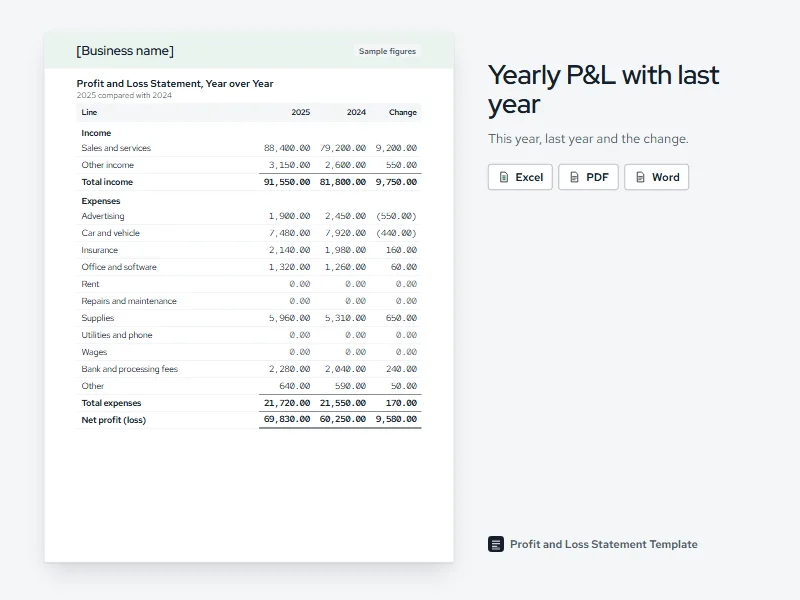
One of the free layouts on our profit and loss statement template page. Type two years of totals and the change column fills itself in.
Calendar year or fiscal year
Most small businesses run their books on the calendar year, January 1 to December 31, because that is the year their owners file taxes on. A business that files on a different fiscal year, say July 1 to June 30, should use that year here instead, so the annual P&L and the tax return cover the same twelve months.
Whichever year you use, the statement only makes sense once the year is over. Partway through the year, a lender wants a YTD profit and loss statement instead: January 1 to a recent date, with last year's annual statement beside it.
An annual example with last year
A made-up mobile pet groomer, 2025 beside 2024. Income rose by 9,750.00 while expenses rose by only 170.00, so almost all of the growth reached the bottom line. Fuel and upkeep fell because a newer van needed fewer repairs, and advertising fell by 550.00 as repeat clients filled the calendar.
Scroll sideways to see every column.
| Line | 2025 | 2024 | Change |
|---|---|---|---|
| Income | |||
| Grooming services | 88,400.00 | 79,200.00 | 9,200.00 |
| Product sales | 3,150.00 | 2,600.00 | 550.00 |
| Total income | 91,550.00 | 81,800.00 | 9,750.00 |
| Expenses | |||
| Van fuel and upkeep | 7,480.00 | 7,920.00 | (440.00) |
| Supplies | 5,960.00 | 5,310.00 | 650.00 |
| Insurance | 2,140.00 | 1,980.00 | 160.00 |
| Phone and software | 1,320.00 | 1,260.00 | 60.00 |
| Advertising | 1,900.00 | 2,450.00 | (550.00) |
| Bank and processing fees | 2,280.00 | 2,040.00 | 240.00 |
| Other | 640.00 | 590.00 | 50.00 |
| Total expenses | 21,720.00 | 21,550.00 | 170.00 |
| Net profit | 69,830.00 | 60,250.00 | 9,580.00 |
Not accounting, tax or legal advice. Check every figure before you sign or submit it. Some lenders require a statement prepared by an accountant.
In the Change column, a figure in parentheses went down. On an expense line that is good news; on an income line it is worth a closer look.
Reading the change column
The Change column gives the difference in dollars. To compare lines of different sizes, turn each change into a percent of last year's figure. In the groomer's year, total income grew by 9,750.00 on 81,800.00, about 11.9%. Total expenses grew by 170.00 on 21,550.00, under 1%. Net profit grew by 9,580.00 on 60,250.00, about 15.9%, faster than income, because costs stayed almost flat.
That last pattern is the one to look for: when income grows faster than expenses, more of each dollar reaches the bottom line. When expenses grow faster than income, find the lines that moved. A single new cost, such as a second vehicle or a new software plan, usually explains most of it.
Your year-end checklist
- Every month is categorized. If you kept a monthly profit and loss statement, the twelve columns already hold the year; if not, sort the whole year's transactions now.
- Non-profit movements are out. Transfers between your accounts, credit card payments, owner draws and loan principal are all left out.
- One-time items are noted. A large equipment purchase, an insurance claim or a one-off contract can make one year look very different from the next. Add a short note so the comparison is fair.
- Totals match the bank. Income should sit close to business deposits after transfers and loans, and the year's profit should make sense against the change in your balances.
- Last year is in the same layout. Use the same lines both years, or the Change column compares unlike things.
- A copy is saved. Keep the finished statement with the year's bank statements. Next year it becomes the last-year column, and a lender may ask for both years at once.
Your annual P&L and your tax return
Your annual P&L and your tax return start from the same records, but they are not the same document. A return can include adjustments a P&L built from bank records leaves out, such as depreciation that spreads the cost of equipment over several years, or the part of a cost that is not deductible. Expect the profit on the return to differ from the statement, and ask your tax preparer to explain the gap rather than forcing the two to match.
If you need the formal layout accountants use, with gross profit, operating income and income tax as separate steps, our income statement template covers it.
Questions
What is an annual profit and loss statement?
An annual profit and loss statement is a P&L that covers twelve months, either the calendar year or your business's fiscal year. It lists the year's income and expenses by category and ends with the net profit for the year. Placing last year's figures beside it shows at a glance what grew and what shrank.
Is my yearly P&L the same as my tax return?
No. Both start from the same records, but a tax return can include adjustments a simple P&L leaves out, such as depreciation of equipment or the part of a cost that is not deductible. Expect the profit on the return to differ, and ask your tax preparer to explain the gap rather than forcing the two to match.
Why compare this year with last year?
A change column shows growth in money terms and points at the costs that moved. In the groomer example, income rose by 9,750.00 while expenses rose by only 170.00, so almost all of the extra income became profit. The template works out the change column with formulas, so you only type the two years.
Should a small business use a calendar or fiscal year?
Use the year your business files its taxes on. For most small businesses, including sole owners, that is the calendar year from January 1 to December 31. If your business uses a different fiscal year, set the period to match it so the P&L lines up with your return.
What should a yearly profit and loss statement include?
It should include the business name, the year it covers, income, any cost of goods sold, expenses by category and net profit, with last year's figures beside this year's. A change column makes growth easy to read. If a lender asks for the statement, sign and date it and add your name and title.
Can I make a yearly P&L from 12 monthly statements?
Yes. Add each line across the twelve months and the totals are your yearly P&L, as long as every month used the same categories. The monthly profit and loss statement template does this for you: its Total column adds every line across the year, so it doubles as your annual statement.