Monthly Profit and Loss Statement
Twelve columns and a total: see each month, the busy season and the year at once.
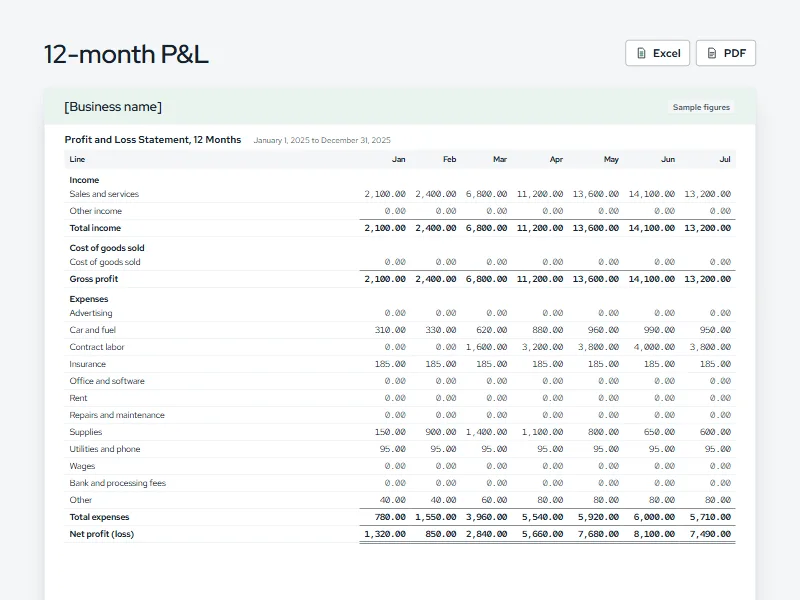
One of the free layouts on our profit and loss statement template page. The Excel file totals every row across the year and every column down the month.
Why track profit month by month
A yearly total hides the shape of the year. Twelve columns show it: the months that carry the business, the months that drain it, and how far apart they are. That matters for three reasons.
- Cash planning. If you know your slow months, you can hold back cash from the busy ones to cover rent and insurance when sales drop.
- Seasonality. Seeing each month side by side tells you when to hire help, when to buy stock and when to take time off.
- Creeping costs. A subscription that doubled, or a card fee that rose a little each month, stands out in a row of twelve figures long before it shows up in a yearly total.
If you only need one month at a time, the simple profit and loss statement template fits on a single page.
How the 12 columns work
Each month has its own column, and you type that month's figures into its shaded cells. Every subtotal down the column is a formula, so total income, gross profit, total expenses and net profit for the month fill themselves in. The Total column at the right adds each row across all twelve months, which gives you the annual statement without a second file.
If your business started partway through the year, leave the earlier months empty; they count as zero. To add a line, insert a row between the first and last line of a section so the totals pick it up, and rename lines freely, because the formulas do not care what they are called.
A 12-month example
A made-up landscaping service from January to December. Services jump from 2,100.00 in January to 14,100.00 in June, and contract labor follows the work, while insurance and phone costs stay the same every month. On a phone, swipe the statement sideways to see every month.
Scroll sideways to see every column.
| Line | Jan | Feb | Mar | Apr | May | Jun | Jul | Aug | Sep | Oct | Nov | Dec | Total |
|---|---|---|---|---|---|---|---|---|---|---|---|---|---|
| Income | |||||||||||||
| Services | 2,100.00 | 2,400.00 | 6,800.00 | 11,200.00 | 13,600.00 | 14,100.00 | 13,200.00 | 12,700.00 | 10,900.00 | 8,300.00 | 4,600.00 | 2,000.00 | 101,900.00 |
| Expenses | |||||||||||||
| Fuel and vehicle | 310.00 | 330.00 | 620.00 | 880.00 | 960.00 | 990.00 | 950.00 | 930.00 | 840.00 | 700.00 | 450.00 | 300.00 | 8,260.00 |
| Equipment and supplies | 150.00 | 900.00 | 1,400.00 | 1,100.00 | 800.00 | 650.00 | 600.00 | 550.00 | 500.00 | 450.00 | 250.00 | 120.00 | 7,470.00 |
| Contract labor | 0.00 | 0.00 | 1,600.00 | 3,200.00 | 3,800.00 | 4,000.00 | 3,800.00 | 3,600.00 | 3,000.00 | 2,200.00 | 800.00 | 0.00 | 26,000.00 |
| Insurance | 185.00 | 185.00 | 185.00 | 185.00 | 185.00 | 185.00 | 185.00 | 185.00 | 185.00 | 185.00 | 185.00 | 185.00 | 2,220.00 |
| Phone and software | 95.00 | 95.00 | 95.00 | 95.00 | 95.00 | 95.00 | 95.00 | 95.00 | 95.00 | 95.00 | 95.00 | 95.00 | 1,140.00 |
| Other | 40.00 | 40.00 | 60.00 | 80.00 | 80.00 | 80.00 | 80.00 | 80.00 | 70.00 | 60.00 | 50.00 | 40.00 | 760.00 |
| Total expenses | 780.00 | 1,550.00 | 3,960.00 | 5,540.00 | 5,920.00 | 6,000.00 | 5,710.00 | 5,440.00 | 4,690.00 | 3,690.00 | 1,830.00 | 740.00 | 45,850.00 |
| Net profit | 1,320.00 | 850.00 | 2,840.00 | 5,660.00 | 7,680.00 | 8,100.00 | 7,490.00 | 7,260.00 | 6,210.00 | 4,610.00 | 2,770.00 | 1,260.00 | 56,050.00 |
Not accounting, tax or legal advice. Check every figure before you sign or submit it. Some lenders require a statement prepared by an accountant.
How to read a seasonal year
Compare a month with the same month last year, not with the month before it. The landscaper's March always beats February, so that jump says nothing about growth; this March against last March does. A yearly profit and loss statement with a last-year column makes the same comparison for the whole year.
Then look at the costs that do not fall in the slow months. In the example, insurance and phone and software cost 280.00 every month whether the crews are busy or not, which is part of why December's profit is so thin. Fixed costs like these set the floor your slow months have to clear.
Your month-end routine
Download the month's files
Get a CSV or statement for every business bank and card account, for the same dates.
Categorize every row
Give each transaction an income or expense line, so the month's column is complete.
Leave out what is not profit
Check that transfers between your accounts and card payments are left out, along with loan principal.
Compare with the bank
Set the month's net profit against the change in your bank balance. A large gap usually means a missing or misplaced transaction.
Save the month
Fill in the month's column and keep the files. At year end, the twelve columns already make the annual statement.
If a lender asks for the year so far, the same months feed a YTD profit and loss statement with a signature line.
Questions
Why make a monthly profit and loss statement?
A monthly P&L shows when money comes in and when it goes out, not just the total for the year. That lets you set cash aside before a slow season, see the effect of a price change within weeks, and spot a cost that creeps up month after month before it eats a whole quarter of profit.
How do I set up a 12-month profit and loss statement?
Use one column for each month and a Total column at the end, with your income and expense lines down the left side. Each month's totals and the Total column should be formulas, so a figure typed into any month flows through to the year. The monthly template is already set up that way.
Should a monthly P&L use cash or accrual?
A P&L built from bank records is on a cash basis: income counts when it lands and costs count when they are paid. Accrual counts them when they are earned or owed instead. Either works for a monthly P&L, but use the same method every month, and ask your tax preparer which one your returns use.
How do I compare one month with another?
If your business is seasonal, compare a month with the same month last year rather than with the month before it. A landscaper's March always beats February, so that jump says little. March this year against March last year shows whether the business actually grew, and costs that stay flat in slow months stand out.
What should I check at the end of each month?
Check that every transaction has a category and that transfers between your own accounts and credit card payments are left out. Then compare the month's net profit with the change in your bank balance: they will rarely match exactly, but a big gap usually points to a missing transaction or a loan payment in the wrong place.
How many months should a monthly profit and loss statement show?
Twelve, for a full year, with a Total column that adds them up. A business that started this year shows the months so far and adds a column as each month closes. Keep the same lines in every month, even when a line is zero, so the months compare cleanly and the total stays correct.