Small Business Profit and Loss Statement
Cost of goods sold, gross profit and payroll, laid out the way a bank expects to see them.
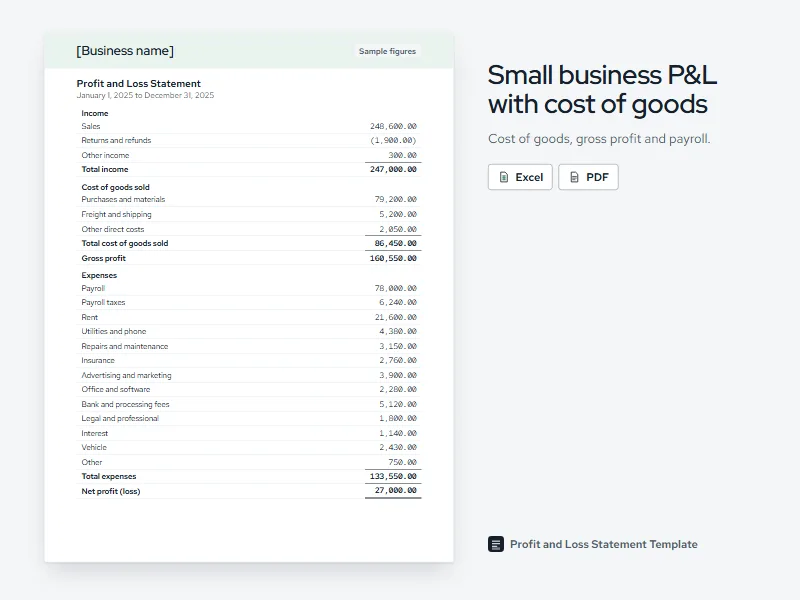
The fullest P&L layout on our profit and loss statement template page, with every subtotal as a formula.
What a small business P&L needs
Once a business sells products or employs people, a short expense list stops being enough. Four things set this layout apart.
- Cost of goods sold and gross profit. Products bought for resale, materials and freight in sit in their own section, so gross profit shows what your sales earn before the running costs.
- Payroll and payroll taxes as separate lines. Wages are usually the largest cost, and the employer's share of payroll taxes comes on top of them.
- Card processing fees. A business that takes cards pays a fee on most sales; giving it a line shows what accepting cards really costs.
- Interest, not loan principal. Only the interest on business loans is an expense. The principal you repay stays off the statement.
This is the layout accountants call a multi step income statement in its simplest form: income, then cost of goods sold, gross profit, operating expenses and net profit.
| Line | Amount |
|---|---|
| Income | |
| Sales | |
| Returns and refunds | |
| Other income | |
| Total income | |
| Cost of goods sold | |
| Purchases and materials | |
| Freight and shipping | |
| Other direct costs | |
| Total cost of goods sold | |
| Gross profit | |
| Expenses | |
| Payroll | |
| Payroll taxes | |
| Rent | |
| Utilities and phone | |
| Repairs and maintenance | |
| Insurance | |
| Advertising and marketing | |
| Office and software | |
| Bank and processing fees | |
| Legal and professional | |
| Interest | |
| Vehicle | |
| Other | |
| Total expenses | |
| Net profit (loss) | |
Where owner pay goes
How you pay yourself depends on how the business is set up, and so does where that pay goes on the statement. A sole owner or a partner takes draws, and draws are not an expense: they are profit leaving the business. When an owner works for their own corporation and is paid through payroll, that pay is usually an expense, because it is wages like anyone else's, with payroll taxes on top.
The structure of your business decides which applies, and some owners take both wages and distributions. Ask your tax preparer how your business pays you before you decide which line it belongs on.
Whichever it is, record it the same way every period. A statement that shows owner pay as wages one year and as draws the next makes the business look as if its costs jumped or fell when nothing changed.
A worked example
A made-up print shop with two employees, one full year. Gross margin is 65.0%: paper, ink and other materials take 35 cents of each dollar of income. Payroll is by far the largest operating cost, and net margin ends at 10.9%. For a cafe, a store and four other businesses, see our profit and loss statement examples.
| Line | Amount |
|---|---|
| Income | |
| Sales | 248,600.00 |
| Returns and refunds | (1,900.00) |
| Other income | 300.00 |
| Total income | 247,000.00 |
| Cost of goods sold | 86,450.00 |
| Gross profit | 160,550.00 |
| Expenses | |
| Payroll | 78,000.00 |
| Payroll taxes | 6,240.00 |
| Rent | 21,600.00 |
| Utilities and phone | 4,380.00 |
| Repairs and maintenance | 3,150.00 |
| Insurance | 2,760.00 |
| Advertising and marketing | 3,900.00 |
| Office and software | 2,280.00 |
| Bank and processing fees | 5,120.00 |
| Legal and professional | 1,800.00 |
| Interest | 1,140.00 |
| Vehicle | 2,430.00 |
| Other | 750.00 |
| Total expenses | 133,550.00 |
| Net profit | 27,000.00 |
Not accounting, tax or legal advice. Check every figure before you sign or submit it. Some lenders require a statement prepared by an accountant.
Each line as a share of income
One quick way to read a small business P&L is to divide each line by total income, sometimes called vertical analysis. For the print shop, cost of goods sold is 35.0% of income, payroll with its taxes is 34.1%, rent is 8.7% and bank and processing fees are 2.1%, leaving a net margin of 10.9%.
The shares matter more than the dollars when you compare years, because they stay meaningful as the business grows. If payroll climbs from 34% to 38% of income while sales stay flat, that change shows up long before the bottom line turns into a loss. Comparing the same shares across several years is called horizontal analysis, and the yearly profit and loss statement template puts last year beside this year to make it easy.
Using it for a bank or SBA loan
Lenders often ask for recent profit and loss statements, such as the last full year and the year so far, and compare them with your bank records and tax returns. Ask which periods they want and whether they need the statements prepared or reviewed by an accountant before you start.
Many lenders also ask for a balance sheet dated the same day the P&L ends, showing what the business owns and owes. Our balance sheet template has a check cell that tells you when it balances.
Questions
What should a small business profit and loss statement include?
It should include sales, any returns or refunds, cost of goods sold and gross profit, followed by payroll and the other operating expenses and, at the bottom, net profit. Payroll taxes, card processing fees and interest each get their own line, so you and your lender can see what each one costs.
Where do payroll taxes go on a profit and loss statement?
The employer's share of payroll taxes is an operating expense with its own line, next to payroll. The taxes withheld from employees' pay are part of their wages, so they already sit inside the payroll line and are not an extra cost. Ask your payroll provider or tax preparer if the split is unclear.
Is the owner's pay an expense on a small business P&L?
It depends on how the business is set up. Draws taken by a sole owner or a partner are not expenses. When an owner works for their own corporation and is paid through payroll, that pay usually is an expense, because it is wages. Ask your tax preparer how your business pays you before you decide where it goes.
What counts as cost of goods sold for a small business?
Cost of goods sold is the direct cost of what you sold during the period: products bought for resale, materials used to make them and, in some businesses, direct production costs such as freight in. Rent, advertising and office costs are operating expenses instead, because you would pay them even without a sale.
Will a bank accept my own profit and loss statement for a loan?
Many lenders accept a statement prepared by the owner, usually alongside your tax returns and bank statements. Others, especially for larger loans, require one prepared or reviewed by an accountant. Ask your lender what they need before you start, then make sure every figure can be traced back to your bank records.
What is gross profit on a small business P&L?
Gross profit is sales minus cost of goods sold. It is what is left to pay rent, payroll and every other operating cost before any profit remains. In the print shop example on this page, gross profit is 160,550.00, which is 65.0% of income, and the operating costs below it bring net profit down to 27,000.00.