Multi Step Income Statement
A multi step income statement reports profit in stages. It subtracts the cost of goods sold from net sales to show gross profit, subtracts operating expenses to show operating income, then adds or subtracts other income, other expenses and taxes to reach net income. A single step statement reaches the same net income in one subtraction.
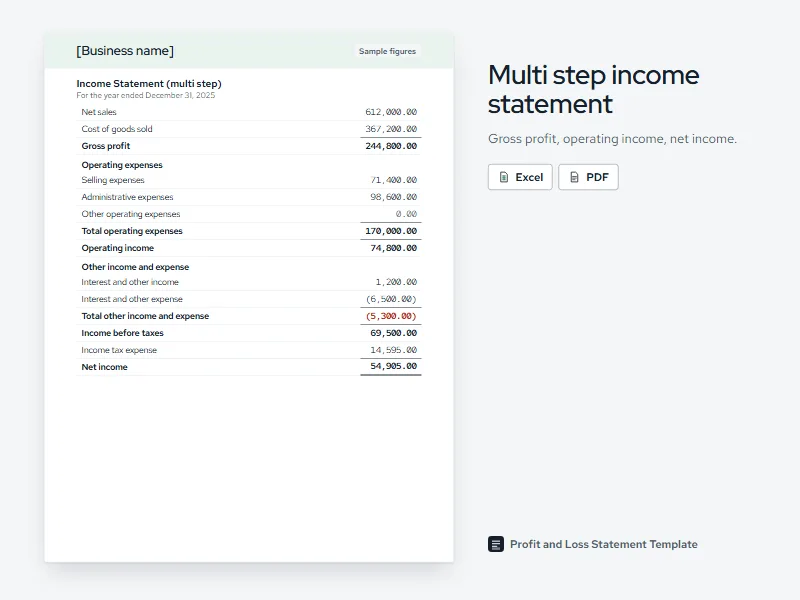
Both files carry every subtotal as a formula. For the standard one-page format with detailed expense lines, use the income statement template.
The steps
Each stage subtracts one group of costs and names what is left. Shown with the figures of a made-up furniture retailer for one year:
1. Net sales to gross profit
| Net sales | 612,000.00 |
| Cost of goods sold | 367,200.00 |
| Gross profit | 244,800.00 |
Net sales are sales after returns and discounts. Taking off what the goods cost leaves gross profit: what the retailer earns on the furniture itself.
2. Gross profit to operating income
| Gross profit | 244,800.00 |
| Total operating expenses | 170,000.00 |
| Operating income | 74,800.00 |
Operating expenses are the costs of running the business: selling expenses such as sales staff and advertising, and administrative expenses such as office salaries, rent and software. What remains is operating income, the profit from the core business.
3. Operating income to income before taxes
| Operating income | 74,800.00 |
| Other income and expense | (5,300.00) |
| Income before taxes | 69,500.00 |
Items outside the main business come next. Here interest earned of 1,200.00 and interest paid of 6,500.00 net to (5,300.00).
4. Income before taxes to net income
| Income before taxes | 69,500.00 |
| Income tax expense | 14,595.00 |
| Net income | 54,905.00 |
Subtracting income tax gives net income, the bottom line. A small business owner who calls the same report a profit and loss statement often stops after the second step, because many small businesses have little other income, and a pass-through business usually pays income tax on the owners' returns instead of its own.
One example, both ways
Here is the retailer's year as a full multi step statement, then the same figures in a single step layout. Both end at 54,905.00.
| Line | Amount |
|---|---|
| Net sales | 612,000.00 |
| Cost of goods sold | 367,200.00 |
| Gross profit | 244,800.00 |
| Operating expenses | |
| Selling expenses | 71,400.00 |
| Administrative expenses | 98,600.00 |
| Total operating expenses | 170,000.00 |
| Operating income | 74,800.00 |
| Other income and expense | |
| Interest income | 1,200.00 |
| Interest expense | (6,500.00) |
| Total other income and expense | (5,300.00) |
| Income before taxes | 69,500.00 |
| Income tax expense | 14,595.00 |
| Net income | 54,905.00 |
Not accounting, tax or legal advice. Check every figure before you sign or submit it. Some lenders require a statement prepared by an accountant.
The single step version puts every revenue in one group and every expense, including cost of goods sold, interest and income tax, in another:
| Line | Amount |
|---|---|
| Revenues | |
| Net sales | 612,000.00 |
| Interest income | 1,200.00 |
| Total revenues | 613,200.00 |
| Expenses | |
| Cost of goods sold | 367,200.00 |
| Selling expenses | 71,400.00 |
| Administrative expenses | 98,600.00 |
| Interest expense | 6,500.00 |
| Income tax expense | 14,595.00 |
| Total expenses | 558,295.00 |
| Net income | 54,905.00 |
Nothing changed but the grouping. What the multi step layout adds is the story in between: a gross margin of 40.0%, and operating income of 74,800.00 before interest and tax.
Where each cost goes
Most of the work in a multi step statement is deciding which stage a cost belongs to. A few rules settle almost every line:
- Cost of goods sold: what the goods you sold cost you, including freight to get them in and, for a maker, the materials and direct labor used to make them.
- Selling expenses: costs of winning and delivering sales, such as sales staff, commissions, advertising, showroom costs and delivery to customers.
- Administrative expenses: costs of running the business as a whole, such as office salaries, rent for the office, accounting fees, insurance and software.
- Other income and expense: anything outside the main business, such as interest earned and paid, or a gain or loss on selling equipment.
- Income tax expense: tax on the business's own profit, which appears only when the business itself pays it.
When a cost could fit two places, pick one and use it every year. Consistency matters more than the perfect answer, because the point of the layout is to compare one year with the next.
The margins it shows
Each stage gives a margin when you divide it by net sales. For the retailer, gross margin is 40.0% (244,800.00 of 612,000.00), operating margin is 12.2% (74,800.00) and net margin is 9.0% (54,905.00). A single step statement shows only the last of these.
The gap between them tells its own story. Here, 40 cents of every sales dollar survive the cost of the furniture, but selling and administrative costs take another 27.8 cents, and interest and tax take the rest of the difference. If the operating margin slips while the gross margin holds, the running costs are growing faster than sales.
Single step or multi step
| Question | Single step | Multi step |
|---|---|---|
| What it shows | Total revenues, total expenses, net income | Gross profit, operating income, other items, net income |
| Who uses it | Very small businesses and quick internal reports | Businesses that sell products, lenders, investors and annual reports |
| Effort | Two groups and one subtraction | Costs sorted into stages, so more decisions about where a line goes |
| Best for | Seeing the bottom line fast | Seeing margins and where profit is made or lost |
If someone else will read the statement, such as a lender, multi step is usually the better choice. For your own monthly check-in, single step is often enough.
In short, pick single step when you only need the bottom line, and multi step when you sell products or want to show gross profit and operating income. Both reach the same net income, so you can start with single step and switch later without changing a single figure.
A services business without cost of goods sold
A consultant, a designer or an agency sells time, not goods, so the first step changes. Start at revenue and go straight to operating expenses, or add a cost of services line for costs that rise with each job, such as subcontractors or freelancers hired for a project. With a cost of services line, the first subtotal is still called gross profit.
From there the stages are the same: operating income, other income and expense, income before taxes and net income. Our profit and loss statement examples include a freelancer and a driver laid out without cost of goods sold.
Whether a services business shows a cost of services line is a judgment call. If most of your costs rise and fall with each project, such as freelancers, materials for a job or hosting for each client, a cost of services line makes your gross margin meaningful. If most costs are fixed, such as your own time, rent and software, skip it and let operating income carry the story. Either way, keep the same layout from year to year so the margins compare.
Questions
What is the difference between a single step and a multi step income statement?
A single step income statement adds up all revenues, adds up all expenses and subtracts one from the other in a single step. A multi step statement takes the same figures in stages, showing gross profit and operating income before it reaches net income, so you can see where the money is made and where it goes.
Do single step and multi step statements give the same net income?
Yes. Both layouts use the same revenues and expenses, so net income is always identical; only the grouping changes. In the furniture retailer example on this page, both versions end at 54,905.00. If your two versions disagree, a line has been left out or counted twice.
Which income statement format should a small business use?
Single step is quicker to prepare and is enough for a business that only needs its bottom line. Multi step takes a little more work but shows gross margin and operating income, which owners use to price their work and lenders use to judge the business. If a lender will read it, multi step is usually the better choice.
Can a service business use a multi step income statement?
Yes. A service business can skip cost of goods sold and start at revenue, or use a cost of services line for the direct cost of delivering the work, such as subcontractors. The remaining steps, from operating expenses to operating income and net income, work exactly the same way.
What are non-operating income and expenses?
They are amounts that come from outside the main business, such as interest earned on savings, interest paid on a loan, or a one-time gain or loss from selling equipment. A multi step statement shows them below operating income, so they do not blur how the core business performed.
What is operating income on a multi step income statement?
Operating income is gross profit minus selling and administrative expenses. It shows how the main business performs before interest, other income and income tax, which is why lenders look at it closely. In the furniture retailer example on this page, operating income is 74,800.00, before interest and tax bring it down to net income of 54,905.00.