Simple Profit and Loss Statement Template
Eight lines, one page: what came in, what went out, what is left.
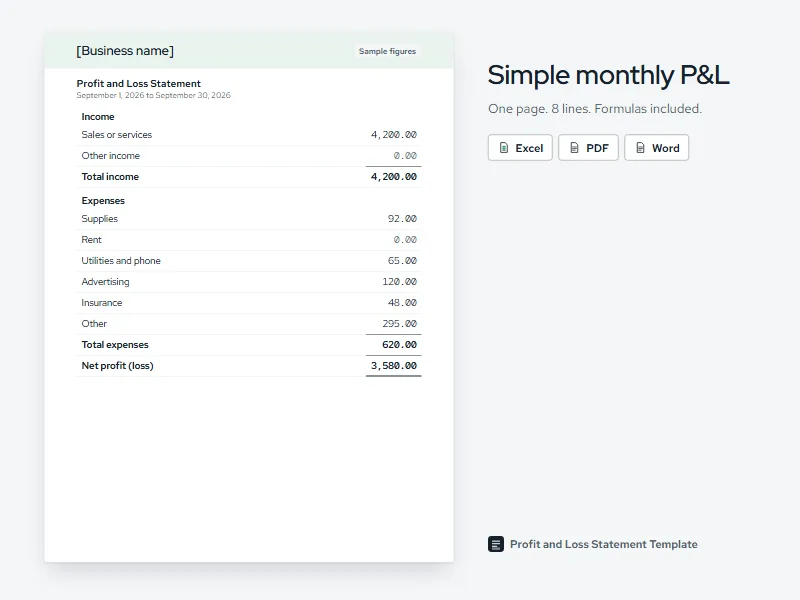
The shortest of the layouts on our profit and loss statement template page. Excel adds the totals for you; the PDF has fields you can type into.
The 8 lines
Two lines for money coming in and six for money going out cover most one-person service businesses. Anything that does not fit goes on Other, and if Other keeps growing, that is the sign you need a fuller layout.
- Sales or services: everything customers paid you for the work or the products.
- Other income: small extras, such as a referral fee or interest on the business account.
- Supplies: materials you use up doing the work.
- Rent: a studio, a desk or a storage unit. Leave it at 0.00 if you work from home.
- Utilities and phone: the business share of your phone, internet and power.
- Advertising: ads, flyers, listings and your website.
- Insurance: liability or business insurance, not health insurance.
- Other: everything else, such as fuel, software or bank fees.
Below them sit three totals, each a formula in the Excel file: total income, total expenses, and net profit (or loss).
| Line | Amount |
|---|---|
| Income | |
| Sales or services | |
| Other income | |
| Total income | |
| Expenses | |
| Supplies | |
| Rent | |
| Utilities and phone | |
| Advertising | |
| Insurance | |
| Other | |
| Total expenses | |
| Net profit (loss) | |
When a simple P&L is enough
A simple P&L suits side businesses, freelancers and service businesses that have no inventory and no staff. If your income comes from a few clients and your costs are a phone, some supplies and a little advertising, eight lines show everything that matters. It is also the easiest statement to keep up every month, which beats a detailed one you only fill in at tax time.
Fill in one copy per month from your bank and card records, leaving out transfers between your own accounts and card payments. Twelve of them make your year, and the totals line up with what your tax preparer will ask for. If the same few costs keep landing on Other, rename a line to match them: the formulas do not depend on the names.
When you need more
Three things outgrow the simple layout. Selling products brings cost of goods sold and gross profit, so you can see what each sale really leaves you. Hiring brings payroll and payroll taxes, which belong on their own lines. Both are covered by the small business profit and loss statement.
The third is a lender. A bank or mortgage company will usually want each expense category shown and the statement signed, often for January 1 to date. For that, use the YTD profit and loss statement, which has the signature lines lenders expect.
A simple example
A made-up dog walking service, one month, on the template's own eight lines. The owner works from home, so rent is 0.00, and car and fuel costs of 260.00 go on Other with 35.00 of small items, which makes 295.00.
| Line | Amount |
|---|---|
| Income | |
| Services | 4,200.00 |
| Other income | 0.00 |
| Total income | 4,200.00 |
| Expenses | |
| Supplies | 92.00 |
| Rent | 0.00 |
| Utilities and phone | 65.00 |
| Advertising | 120.00 |
| Insurance | 48.00 |
| Other | 295.00 |
| Total expenses | 620.00 |
| Net profit | 3,580.00 |
Not accounting, tax or legal advice. Check every figure before you sign or submit it. Some lenders require a statement prepared by an accountant.
Questions
What is a simple profit and loss statement?
A simple profit and loss statement is a one-page P&L with only a handful of lines: income, a few groups of expenses and the net profit at the bottom. It leaves out cost of goods sold, payroll and other detail, so it is easy to fill in from your bank records and easy for anyone to read.
Who should use a simple P&L?
Side businesses, freelancers and small service businesses with no inventory and no employees are the best fit. If your income comes from a few clients and your costs are supplies, a phone, some advertising and insurance, the eight lines cover everything you need to see.
When is a simple P&L not enough?
When you sell products, run payroll or need to show a lender more detail. Products bring cost of goods sold and gross profit, payroll brings wages and payroll taxes, and lenders often want a year to date statement with each expense category shown. Each of those has its own template on this site.
Can I make a simple P&L in Word instead of Excel?
Yes. The simple template comes as a Word document with the same eight lines, which suits you if you prefer to type figures into a table and print it. The difference is the math: Word will not add the lines up, while the Excel version and the form to fill in a P&L online both total them as you type.
What goes in the Other line on a simple P&L?
Small costs that fit none of the named lines go in Other, such as bank fees, postage or a small software subscription. Keep it small. If Other grows into one of your biggest lines, give that cost a line of its own, so you and anyone reading the statement can see where the money actually goes.
Should a simple profit and loss statement cover a month or a year?
Either one works, as long as the period is printed at the top. A month is the better habit for running the business, because a problem shows up while you can still act on it. A full year is what your tax preparer and most lenders ask for, and twelve monthly statements add up to it.