YTD Profit and Loss Statement
From January 1 to the date your lender needs, signed and dated, in a layout lenders recognize.
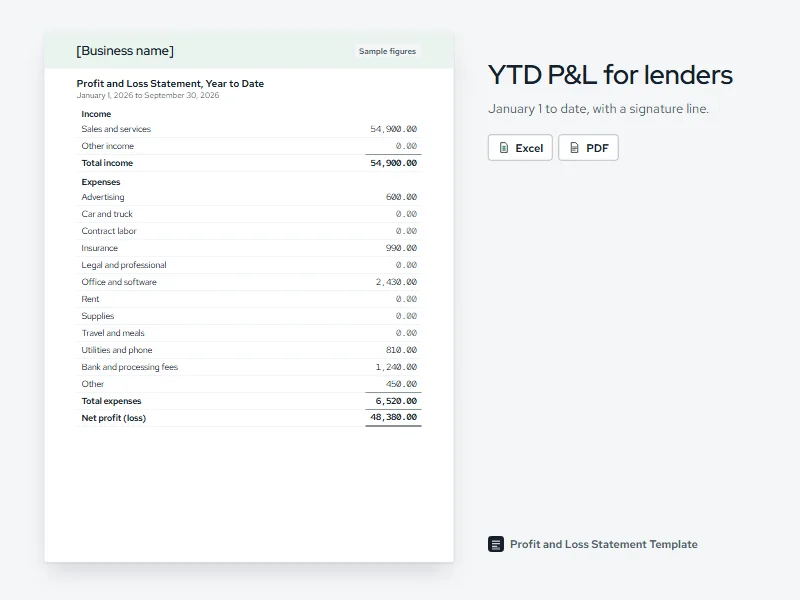
The lender layout from our profit and loss statement template page. The fillable PDF has fields for every line and for your signature details.
What year to date means
Year to date runs from the first day of your business year to a date you choose. For most small businesses the start is January 1; a business on a fiscal year starts at its own first day instead. The end is usually the last day of the most recent full month, so a statement prepared in mid October covers January 1 to September 30.
Ending on a month end keeps the statement easy to check: it lines up with a bank statement the lender can ask to see, and nothing from a half-finished month sneaks in.
What lenders look for
Underwriters read a YTD statement against your bank statements and last year's tax return. They usually expect to see:
- the business name and the exact period at the top;
- income and expense lines that match what went through your business accounts;
- net profit at the bottom, a loss shown as a loss;
- your signature, the date you signed, and your name and title.
Some lenders accept a statement you prepared yourself; others require one prepared or reviewed by an accountant. The rules vary by lender and by loan, so ask yours before you start. If you are self-employed, the self employed profit and loss statement uses Schedule C style lines, which makes it easy to compare with your return.
Questions to ask your lender first
- Which period should it cover, and which end date?
- Do you want totals only, or each month shown?
- Can I prepare and sign it myself, or does an accountant need to prepare or review it?
- Should it cover every business account, including cards and payment apps?
- Do you need the bank statements for the same months with it?
Five answers up front save a second round of paperwork later. Write the answers down, because the same lender may ask for an updated statement before the loan closes.
A lender-ready example
A made-up freelance bookkeeper, January 1 to September 30, 2026, in the lender layout. The signature block sits under the statement, with a line saying who prepared it and that it is not audited. To fill in the same layout on screen and download it, use the fillable profit and loss statement PDF.
| Line | Year to date |
|---|---|
| Income | |
| Bookkeeping services | 54,900.00 |
| Total income | 54,900.00 |
| Expenses | |
| Software and subscriptions | 2,160.00 |
| Continuing education | 450.00 |
| Insurance | 990.00 |
| Phone and internet | 810.00 |
| Advertising | 600.00 |
| Office supplies | 270.00 |
| Bank and processing fees | 1,240.00 |
| Total expenses | 6,520.00 |
| Net profit | 48,380.00 |
Prepared by the owner from bank and card records. Not audited.
Not accounting, tax or legal advice. Check every figure before you sign or submit it. Some lenders require a statement prepared by an accountant.
If your business started this year
A business that opened after January 1 has no earlier months to report, so its year to date statement starts on the day it began trading. Say so in the period line, for example "For the period April 15, 2026 to September 30, 2026", rather than starting at January 1 with empty months.
A new business also has no tax return yet, which makes the YTD statement more important to a lender, not less. Expect to be asked for every bank statement since the account opened, and keep business and personal spending in separate accounts from the start, so the statement and the bank records agree line by line.
Tie it to your bank statements
Before you send it, check the statement the way the lender will. Add up the deposits on your business bank statements for the same months, then take out transfers from your own accounts and any loan money. What is left should be close to the income on your P&L; a small difference from timing is normal, a large one means something is missing or counted twice.
Keep the bank statements ready to send with it. If you already keep a monthly profit and loss statement, the YTD figures are simply the months so far added together, and each month has already been checked against the bank.
Questions
What does YTD mean on a profit and loss statement?
YTD means year to date. A YTD profit and loss statement runs from the first day of your business year, usually January 1, to the date printed on the statement. It shows the income and expenses for that part of the year, which is why lenders ask for one when your last tax return is months old.
Why do mortgage lenders ask for a YTD profit and loss statement?
Lenders want proof of what you have earned since your last tax return, especially when you are self-employed and have no pay stubs. They compare the statement with your bank statements and your returns. Ask your lender which period they need, whether it must be signed, and whether an accountant has to prepare it.
Does a YTD profit and loss statement need to be signed?
Lenders usually ask you to sign and date it, which is why our template has a signature line, a date line and a name and title line. Some lenders go further and want the statement prepared or reviewed by an accountant. Ask before you send it, because a statement in the wrong form can hold up an application.
What end date should my YTD P&L use?
Use the last day of the most recent full month, unless your lender names a date. A statement that ends on September 30 lines up with your September bank statement, so the lender can check the figures against it. A date in the middle of a month makes that check harder.
Can a YTD profit and loss statement show a loss?
Yes. Report the figures as they are, even if expenses were higher than income so far this year. Lenders compare the statement with your bank statements and tax returns, so a figure that has been rounded up will not hold. Add a short note if the loss has a clear reason, such as a large one-time purchase.
Should my YTD profit and loss statement compare with last year?
It often helps. Putting the same months of last year beside this year shows a lender whether the business is growing, and it answers a question they may ask anyway. Add the comparison if your records go back that far, and ask your lender whether they prefer one column or two.